John Muir in India

On September 29, 1903, John Muir arrived at the Indian port at Calcutta (Kolkata) in 1903 from a ship named Bengala.   He spent the following month traveling all around the Indian subcontinent.  This little known expedition reveals a great deal about the interests, spirituality, and unique tolerance John Muir exhibited on this portion of his around-the world travels in 1903-1904.

Muir began his exploration from the Great Banyan Tree in the Royal Botanic Garden. His exploration ended in Bombay (Mumbai), covering Himalayan peaks and gardens of Darjeeling, Ghats of Varanasi (Benares), traces of the historic siege in Lucknow and Kanpur, the beauty of Taj Mahal at Agra, forts and gates of Delhi, and his most favorite, the Deodar Trees and snowy mountain peaks in Shimla.

Despite the growing recognition of John Muir’s global influence, his 1903 visit to British India at the age of 65 is a little-known part of his life.  Documenting and retracing his trip India is challenging, as all we have to go on are journal entries, a few letters home, and a smattering of newspaper articles. 

New Research by Harold W. Wood Jr. and Dr. Chander Mohan Parsheera of Himachal Pradesh University, Shimla, retracing Muir’s travels in India, offers a fascinating view of this part of Muir’s adventurous life.

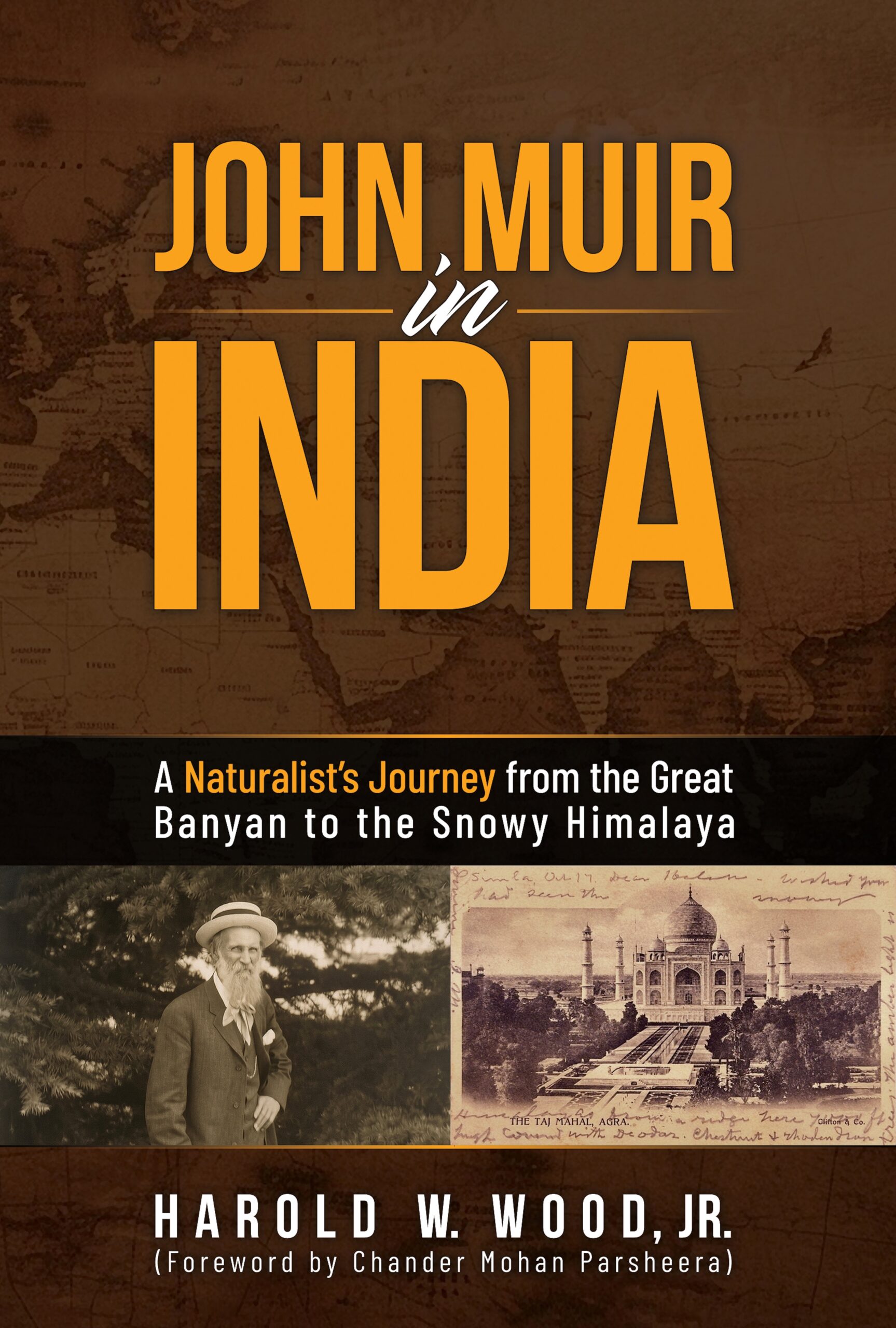
Book Cover - John Muir in India by Harold Wood

In 2025, after a year of extensive research, Dr. Chander Mohan Parsheera of Himachal Pradesh University, Shimla, accompanied by Ms. Surjeet Chatterjee, retraced Muir’s travels throughout the subcontinent of India, following the path that Muir took in 1903. Their goal was to bridge the gap between contemporary India and the experiences Muir had 121 years ago; thereby providing his followers with a well-structured itinerary to retrace his footsteps. By promoting a tourism “John Muir Trail India,” Dr. Parsheera and Ms. Chatterjee hope “to intertwine the legacy of John Muir, a pioneer of modern environmentalism, with the diverse natural and cultural landscapes of India. By carefully tracing Muir’s journey in India and aligning it with his philosophy of conservation and exploration, the trail can serve as a bridge between history, ecology and community development” He hopes that his research and forthcoming book about it will highlight the potential of the trail “to not only celebrate Muir’s environmental ideals but also to address modern challenges such as biodiversity loss, climate change and unsustainable tourism. Through innovative trail design, stakeholder engagement and sustainable practices, the John Muir Trail India can become a model for eco-tourism and a source of inspiration for global conservation efforts.


A book about the research and the trip, with a Foreword by Harold W. Wood, Jr., will be published soon (as of 2025)”

Surjeet Chatterjee, Dr. Amit Arya, Vice Chancellor of a university near Delhi, and Chander Parsheera

On October 11, 2025, Penguin Random House India held a Book Cover Launch for the new book John Muir Trail India.

In the photo above, authors Surjeet Chatterjee and Chander Parsheera are accompanied by Dr. Amit Arya, Vice Chancellor of a university near Delhi (center).

Foreword by Harold W. Wood, Jr., for book John Muir Trail India: Rediscovered After 121 Years,
 by Chander Mohan Parsheera and Surjeet Chatterjee (2025)

John Muir Trail India: Rediscovered After 121 Years,
by Chander Mohan Parsheera and Surjeet Chatterjee (2025)

Foreword by Harold W. Wood, Jr.
Tucson, Arizona

In this accomplished study, tourism specialists Professor Chander Mohan Parsheera(Himachal Pradesh University, Shimla, India) and his associate Ms. Surjeet (Eshita) Chatterjee join a long tradition of people who were fascinated by Muir’s famous walks and travels. While others have previously taken the effort to re-trace Muir’s footsteps, most of them have focused on routes that Muir had written extensively about himself. But the authors here have focused on something much more challenging – a region that few are aware that Muir ever visited, and for which Muir created no published writings.

As a boy I lived in India’s Himalyan foothills for over a year, and subsequent visits to other parts of India has firmly affixed India into my heart. I have embraced its diversity, its vibrancy, and the warmth and spirituality of its people. When I first read books by and about John Muir as a teenager, I did not yet know his connection to India, but I was overjoyed a few years later to discover that connection. I was drawn to the idea of combining what I knew from my first-hand experiences in India with my knowledge and life-long interest in John Muir and his legacy

As webmaster of the John Muir Exhibit website for over 30 years, and more recently the John Muir Global Network website, my interest in Muir’s overseas travels has continued to grow. In between other projects, I embarked on a study of Muir’s original journals and letters written during his India sojourn. In 2006 I presented a photographic presentation about Muir’s travels to India at the John Muir conference held at the University of the Pacific in Stockton, California. Because of this, in 2024, Michael Wurtz at the university referred Professor Parsheera to me. With my own illustrated book project about John Muir’s time in India still in progress, I was delighted to learn of Dr. Parsheera’s planned tourism-focused sojourn retracing of Muir’s travels in India.

Over the years, a number of scholars, photographers, journalists, and Muir aficionados  have been able to discover the most likely routes for some of the long walks and excursions that Muir took over a hundred years ago. They used geographical clues in Muir’s books and journals, and sometimes, botanical specimens that had Muir collected, and then compared them to modern maps.  Most of these, however, have been limited to America. 

Previous efforts to physically walk in Muir’s footsteps succeeded in recreating several of Muir’s most famous journeys, including his well-known 1,000 Mile Walk to the Gulf of Mexico (1867-1868);  his walk on foot from San Francisco to Yosemite (1868); and Muir’s travels with the Harriman Alaska Expedition of 1899, which  was retraced by modern explorers in 2001. 

The result of all these journeys and re-tracings have been numerous articles, books, films, websites, and museum displays chronicling these contemporary re-tracings of Muir’s wandering paths around America.

While Muir’s travels outside the American West have historically been less well-known to his admirers in the United States, this is changing. Recent scholarship has brought new attention to his global journeys, including Bruce Byers’s 2012 work on Muir’s path in Chile’s Monkey Puzzle Forests and Robert Burcher’s 2020 book detailing his identification of modern locations for Muir’s 1864 saunters in southern Canada. In 2001, Michael P. Branch compiled an excellent compilation of Muir’s journals and selected correspondence covering Muir’s 1911-1912 trip to South America and Africa, but he did not attempt to retrace Muir’s path in those two “hot continents.”  Earlier works explored Muir’s travels in Australia and New Zealand, but those scholars likewise did not address how those locations fare today.

Recent efforts in Scotland to promote green tourism using John Muir’s legacy perhaps provides a template for a future similar effort in India, as this book envisions. John Muir’s birthplace in Dunbar is not only an increasingly popular tourism destination in its own right, it also serves as the starting point of the John Muir Way. This 124-mile walking and cycling trail across Scotland’s heartland invites people to connect with nature, as it passes through countryside, coastal towns, cities and villages. The John Muir Way recognizes that connecting people with nature is even more important in less “wild” areas.

Despite the growing recognition of John Muir’s global influence, his 1903 visit to British India at the age of 65 is a little-known part of his life.  Documenting and retracing his trip India is challenging, as all we have to go on are journal entries, a few letters home, and a smattering of newspaper articles. 

Using both poetic and scientific language, Muir’s published works always sought to “entice people to look at nature’s loveliness” by depicting a divine and benign wilderness. By contrast, his private journals often included details like hotel names, travel times, names of places visited, and encounters with people. Yet, reconstructing his travels in India from these scant notes remains challenging given the country’s vast geography and the fact that place names have frequently changed over time. Moreover, modern asphalt highways, buildings, steel bridges, sprawling suburbs, and large dams and reservoirs have frequently replaced the landscape Muir saw in his time. Unlike the long walks that Muir made on foot retraced by previous  scholars—such as his 1,000-mile walk through the American South — Muir’s journey through the Indian Subcontinent required him to navigate vast distances.  He used diverse modes of transportation – including trains, horse-drawn carriages, rickshaws, and boats, as well as “shoe leather” – and these modes of transportation continue in use today in India. Given India’s sprawling size and sometimes remote destinations, modern travelers often need to add air travel to the itinerary, as Dr. Parsheera has done.

Professor Parsheera painstakingly researched locations from Muir’s trip to identify those that may still exist.  Joined by his colleague Ms. Chatterjee, he physically retraced the route that Muir took to confirm these locations.  Retracing John Muir’s journey in India led to a discovery that despite the transformations that the past 121 years, much timeless beauty continues to endure. The Kanchenjunga and deodars of Shimla that Muir witnessed remain as majestic and enchanting as ever. In Darjeeling, the rolling valleys, the layered ridges, and the shimmering outlines of snowy distant peaks that Muir was so grateful to see are still there.  The majesty of the Taj Mahal that Muir admired continues to be a world-class travel destination. In crowded cities like Varanasi, important ancient cultures and vibrant traditions that Muir respected persist.

By replicating Muir’s travels in India, Dr. Parsheera and Ms. Chatterjee bring a historical journey to life and demonstrate its ongoing value. One of the researchers’ most significant discoveries was that while staff at the Botanic Gardens, hotel operators, and tourism guides were largely unaware of John Muir’s legacy until the authors told them about John Muir, many expressed a strong interest in learning more and visibly connecting his work to their own locations.

Inspired by John Muir’s legacy, the “John Muir Trail India” project offers a sustainable and eco-friendly travel itinerary to promote his conservation philosophy in India. By doing so, it hopes to inspire India to further protect its natural and cultural treasures, especially its historical gardens.

John Muir’s global significance extends far beyond the American West and his native Scotland, proving him to be, as the authors suggest, “equally important to everywhere on this earth as he was once in California, Sierra and Yosemite Valley.”  By giving his pivotal journey to India its deserved place alongside his more celebrated travels, this book encourages Muir’s admirers to expand their appreciation for John Muir’s legacy. Ultimately, the authors also issue a challenge to India’s tourism, environmental education, and government conservation sectors: to embrace Muir’s timeless inspiration to protect the nation’s own natural and cultural heritage.

# # #